

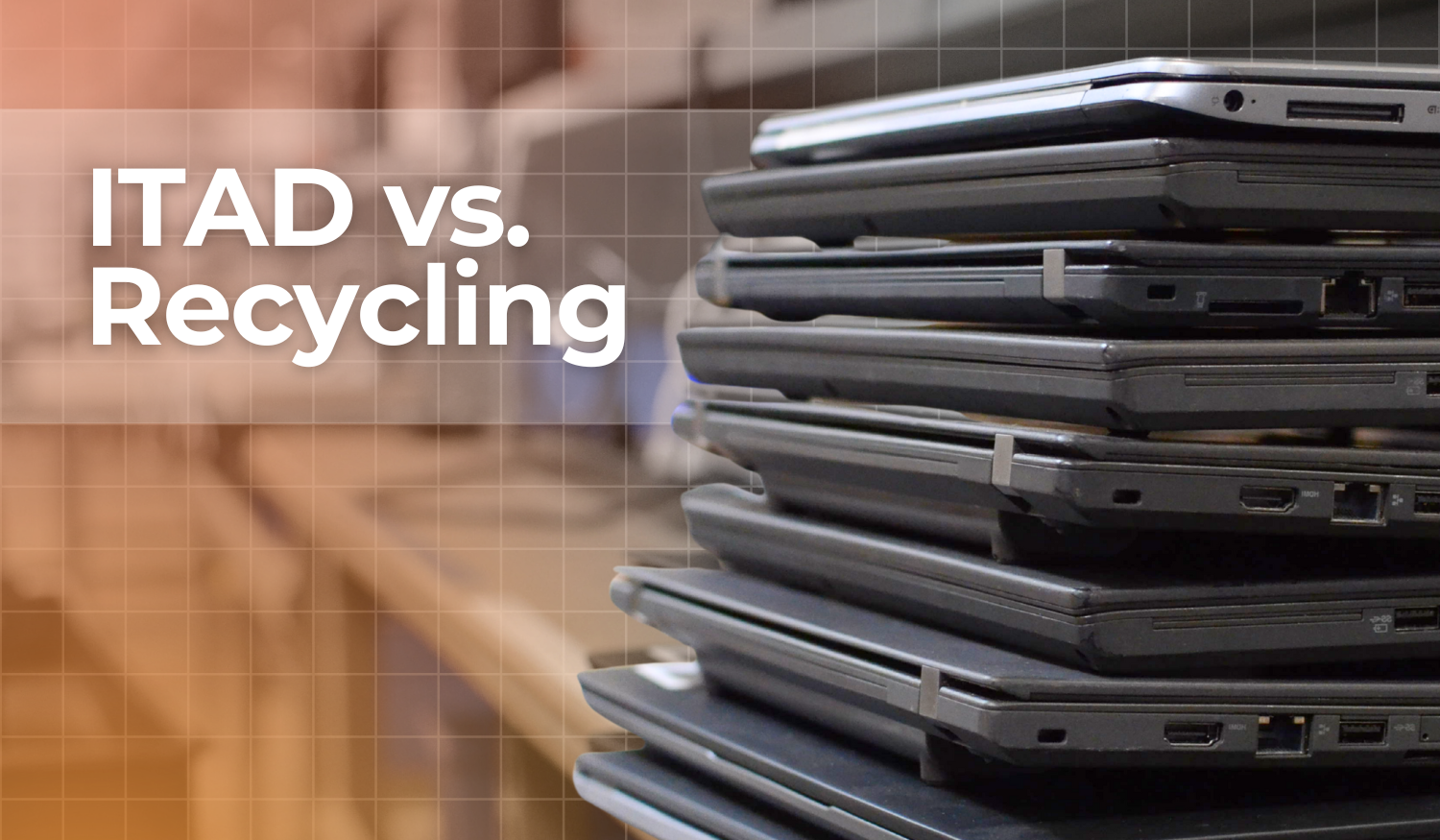
When technology reaches the end of its life in your organization, you’ve got two main paths: IT Asset Disposition (ITAD) or Recycling.
Both aim to keep old devices out of landfills, but the similarities pretty much end there. Choosing the right route impacts everything from data security to financial return — and it’s not a decision to take lightly.
What is ITAD?
IT Asset Disposition is a comprehensive, strategic process for managing retired technology. It goes far beyond simply “getting rid” of old hardware.
Key elements of ITAD:
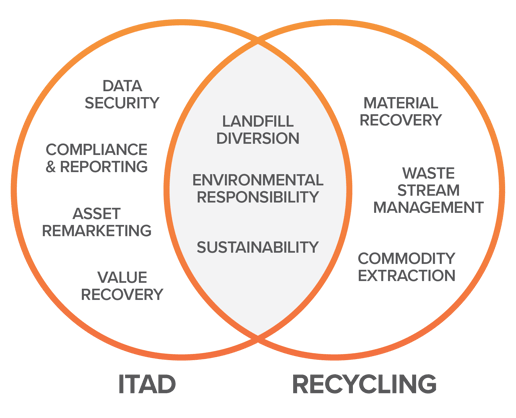
- Secure data destruction using certified processes (e.g. R2v3, NIST 800-88 standards)
- Remarketing and resale of devices to recover maximum value
- Detailed tracking and reporting for every asset
- Regulatory compliance with certifications like R2v3, ISO 9001, ISO 14001, ISO 45001
Why organizations choose ITAD:
- Maximize residual value from usable devices
- Protect sensitive information with airtight data security
- Meet internal and external compliance requirements
- Get transparent, auditable reports on exactly what happened to every asset
What is Recycling?
Recycling focuses on breaking down old equipment into raw materials like metals, plastics, and glass. It’s a vital environmental process, but it’s not designed to handle security, resale, or compliance in depth.
Key elements of recycling:
- Material separation and shredding
- Extraction of valuable raw materials (gold, copper, aluminum, plastics)
- Proper management of waste streams to prevent landfill dumping
Why organizations choose recycling:
- Environmentally responsible disposal
- Recover commodity materials for reuse
- Useful for assets with little to no resale value
Side-by-Side Comparison
| Factor | ITAD | Recycling |
| Primary Goal | Maximize asset value and ensure security | Recover raw materials for environmental gain |
| Data Security | Certified, documented data destruction | Minimal or secondary (unless certified) |
| Resale Potential | High — remarketing is a core focus | Rarely, if ever |
| Compliance | Strong — meets regulatory and certification standards | Less stringent |
| Environmental | Prefers reuse first, then recycle | Focused on recycling only |
| Financial Return | Often significant via resale | Limited to commodity value |
When to Use Each
-
ITAD: Use when devices still have value, contain sensitive data, or when compliance and documentation are essential.
Example: A batch of laptops from a recent upgrade that still function well.
-
Recycling: Use when devices are obsolete, broken beyond repair, or have no resale market.
Example: Shredded circuit boards, damaged monitors, or outdated peripherals.
The Big Takeaway
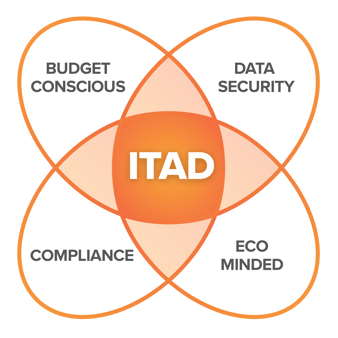
Think of ITAD as a full-service solution—it’s where compliance, data security, environmental responsibility, and fiscal responsibility meet. Recycling is an important part of that ecosystem, but it’s a narrower tool, focused purely on material recovery.
If your assets still hold value and sensitive data, ITAD should be your go-to. If they’re at the point of no return, recycling keeps them out of the landfill responsibly.
What ITAD Adds That Recycling Alone Does Not
For organizations retiring laptops, tablets, desktops, servers, or mixed technology assets, recycling is only one possible outcome. A complete enterprise ITAD program starts earlier in the process: asset pickup, serialized tracking, data sanitization, resale evaluation, reporting, and responsible recycling for equipment that cannot be reused.
That distinction matters because most retired IT assets still carry three kinds of risk: stored data, compliance exposure, and recoverable value. Recycling can help with end-of-life material handling, but IT asset recovery services help organizations decide which assets should be resold, which should be securely processed, and which should be recycled only after value and data security have been addressed.
ITAD vs. Recycling Decision Checklist
| Question | If Yes, ITAD Is Usually Better |
|---|---|
| Do the devices contain business, student, patient, customer, or employee data? | You need documented data sanitization, destruction records, and an audit trail. |
| Do the assets still have resale or redeployment value? | A recovery-first process can return value before recycling is considered. |
| Will finance, legal, IT, security, or compliance ask for proof later? | You should expect serialized reporting, chain of custody, and final disposition records. |
| Are you retiring devices across multiple locations or departments? | A structured ITAD workflow helps prevent lost assets, missed drives, and reporting gaps. |
The Best Programs Use Both
The right question is not always “ITAD or recycling?” In a mature program, recycling is one controlled step inside the larger ITAD process. Reusable assets are graded and remarketed when appropriate. Data-bearing assets are sanitized or destroyed with documentation. Non-recoverable equipment is then routed into responsible recycling.
If your team needs stronger documentation, start by reviewing what should be included in an ITAD chain of custody, what belongs in a certificate of data destruction, and how IT, security, and compliance teams can use an ITAD audit trail after assets leave the building.
Quick Answer: When Should You Choose ITAD?
Choose ITAD when retired assets contain data, have resale value, require compliance documentation, or need serialized tracking from pickup through final disposition. Choose recycling alone only when assets have no practical reuse value, no remaining data risk, and no reporting requirement beyond responsible material recovery.
Need help deciding which assets should be recovered, resold, destroyed, or recycled? Tech Defenders helps organizations build secure, documented ITAD workflows that protect data, recover value, and support compliance. Learn more about our enterprise ITAD services or our IT asset recovery process.